Operating cases and bay capacity
Define products, tanker sizes, daily and peak movements, unloading and loading rates, operating hours, simultaneous operations, queue allowance and the required number of positions.
 CangZhou Simei Energy
Oil terminal · Road tanker facilities
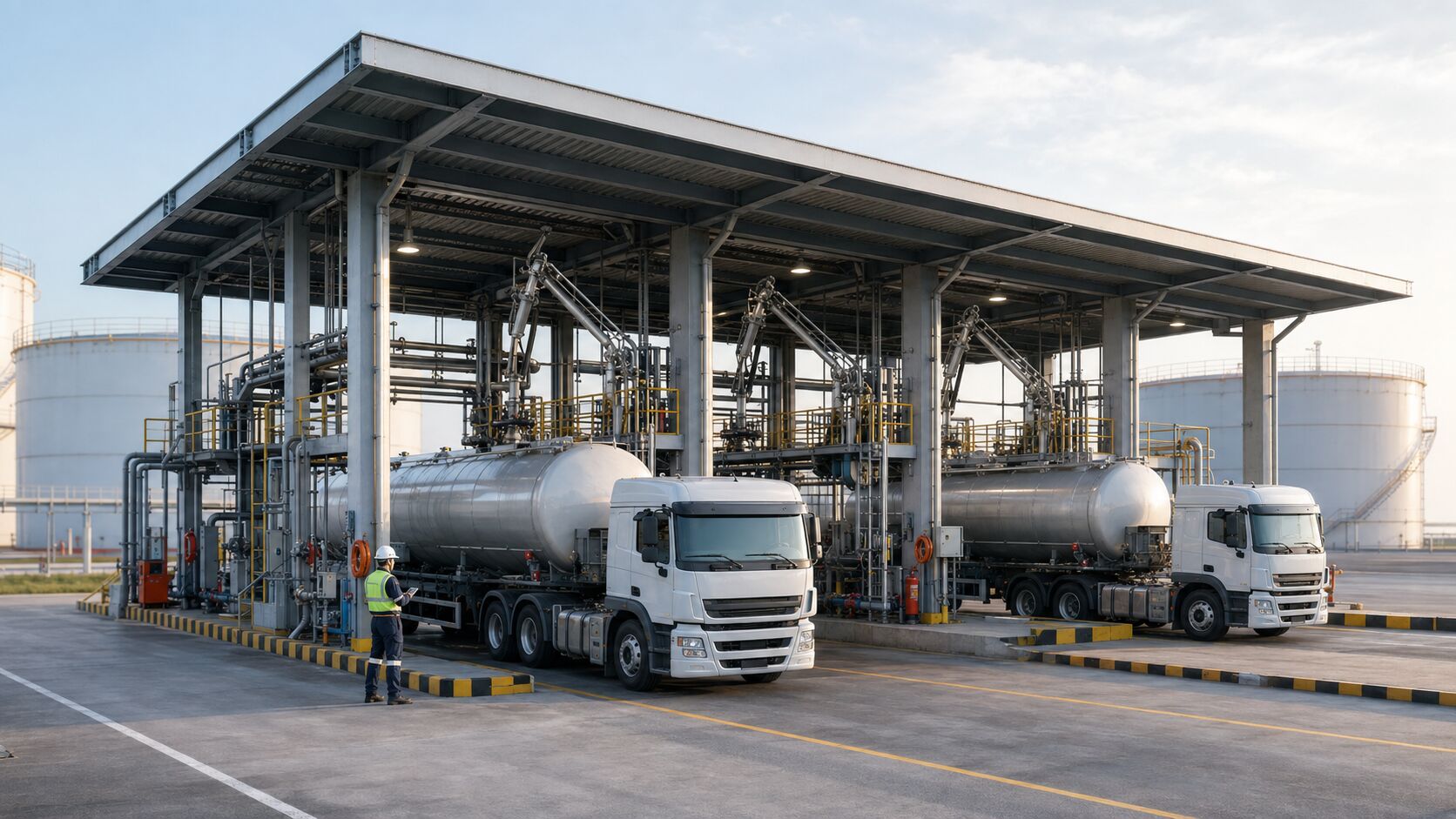
Simei Energy plans and delivers road-tanker receipt and dispatch areas as complete terminal facilities, coordinating traffic flow, unloading bays, loading gantries, civil works, drainage, transfer piping, safeguards, utilities and commissioning for projects in Africa and the Middle East.
Layout · Civil · Operations
A safe facility is more than loading equipment. Vehicle movement, simultaneous operations, product routing, containment, structures and emergency access must be designed as one operating area.
Define products, tanker sizes, daily and peak movements, unloading and loading rates, operating hours, simultaneous operations, queue allowance and the required number of positions.
Plan entry and exit, one-way movement where practical, turning paths, queuing, weighbridge interfaces, parking, safe separation, emergency escape and future expansion.
Coordinate slabs, islands, gantry or canopy structures, kerbs, slopes, sumps, controlled drainage, oily-water collection, spill containment, lighting and maintenance access.
Develop unloading headers, loading manifolds, piping routes, pump duties, filtration, valves, metering interfaces, vapor return where required and segregation against cross-contamination.
Integrate ESD stations, monitored grounding, overfill interfaces, permissives, emergency release where selected, fire protection, hazardous-area electrical design, alarms and terminal control.
Provide power, instrument and communication interfaces, drainage operations, access control, signage, lighting, operator shelter where required, inspection access and commissioning sequences.
01
Engineering starts from the site boundary and survey, products, tanker envelope, receipt and dispatch demand, operating schedule, upstream and downstream tank duties, utilities, rainfall and drainage criteria, hazardous-area basis, fire philosophy, local road and petroleum regulations and owner operating procedures. Layout, quantities and duties remain conditional until these inputs are approved.
02
The contracted scope may include design basis, traffic and turning review, plot plan, bay arrangement, process narrative, PFDs and P&IDs, hydraulic calculations, equipment and line lists, civil and structural interfaces, drainage and containment details, hazardous-area inputs, control philosophy, cause-and-effect interfaces, quantities and construction packages.
03
Simei Energy can coordinate unloading connections, hoses or arms, loading gantries, pumps, manifolds, valves, filtration, metering, grounding and overfill interfaces, vapor return, ESD equipment, steelwork, electrical and control packages. The supply may be integrated with foundations, slabs, drainage, piping, installation, inspection and site construction under an agreed scope.
04
Pre-commissioning and handover can cover cleaning and pressure tests, instrument and loop checks, permissive and ESD verification, grounding and overfill tests, metering checks, dry and product trials, procedures and operator training. For detailed loading arms, bottom-loading, batch control and equipment selection, see the dedicated loading-rack systems page. The client funds and pays for the project; Simei Energy does not provide investment, financing, EPC+F, BOOT, lease-to-own or deferred-payment funding.
Google & AI search answers
An unloading bay receives product from a road tanker into terminal storage. A loading rack dispatches product from storage into tankers. They use different hydraulic duties and operating sequences, although traffic, containment, grounding and emergency systems must be coordinated.
The number depends on daily and peak tanker movements, tanker capacity, connection time, transfer rate, documentation time, operating hours, simultaneous product demand, queue tolerance, maintenance availability and future growth.
They can share selected infrastructure only when the approved design maintains product segregation, correct materials, dedicated or controlled routing, contamination prevention, vapor and hazardous-area requirements and clear operating procedures.
Yes. Slopes, kerbs or other containment, sumps, drainage isolation, oily-water handling and spill response are developed from credible releases, rainfall, firefighting water, environmental limits and the approved operating philosophy.
Yes, where required by the product, tanker fleet, owner standard or regulation. Detailed loading-arm configuration, batch control, grounding and overfill interfaces are covered on the loading-rack systems page.
Provide the site plan, products, tanker dimensions and compartment arrangement, daily and peak movements, target rates, receipt and dispatch routes, tank and pump data, utilities, rainfall, fire basis, local regulations and required delivery boundary.
Yes. Subject to confirmed inputs and the agreed contract, Simei Energy can provide engineering, equipment supply, construction integration, testing, commissioning and complete EPC. We do not provide investment, financing, EPC+F, BOOT, lease-to-own or deferred-payment funding.
Road-tanker facility
Send the country, site plan, products, tanker sizes, daily movements, target loading and unloading rates and required delivery scope.