Storage autonomy and reserve policy
Convert demand, import dependence, disruption scenarios, minimum operating stock and target reserve days into gross, working and unavailable volume by product.
 CangZhou Simei Energy
Oil terminal type · National and commercial fuel security
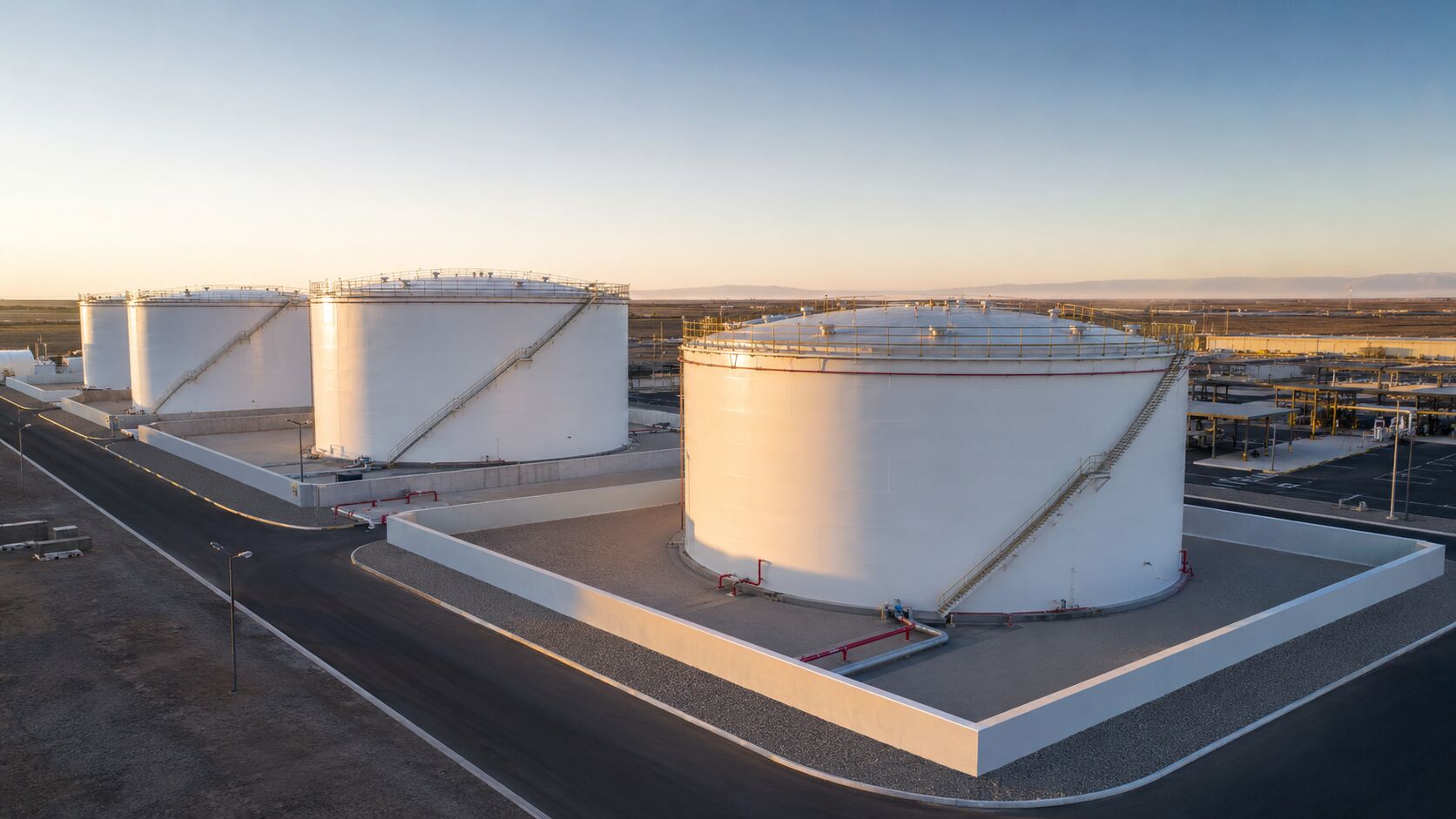
Simei Energy plans, engineers and delivers strategic gasoline and diesel reserve terminals across Africa and the Middle East, translating required storage autonomy, supply disruption scenarios and emergency release obligations into a buildable tank farm, receipt, protection and dispatch system.
Reserve days · Resilience · Emergency release
A strategic reserve is not simply a larger commercial depot. Capacity policy, stock rotation, independent operating routes, emergency drawdown and long-term asset integrity must be established before tank quantities and equipment are fixed.
Convert demand, import dependence, disruption scenarios, minimum operating stock and target reserve days into gross, working and unavailable volume by product.
Separate gasoline, diesel and other approved grades while providing practical receipt, recirculation, sampling, quality control and first-in/first-out rotation routes.
Size marine, pipeline or road receipt together with loading, transfer and metering capacity needed for routine replenishment and credible emergency release.
Define redundancy, independent transfer paths, utilities, spare capacity and expansion corridors so a single outage does not disable essential reserve functions.
Coordinate bunds, firewater and foam, overfill prevention, lightning and static protection, access control, tank gauging and reconciled inventory records.
Plan operating authority, release approvals, inspection intervals, critical spares, emergency exercises, operator competence and lifecycle maintenance from the design stage.
01
The owner should provide country and site, products, demand and import data, required reserve days, normal stock, disruption scenarios, receipt and dispatch modes, release targets, land, survey information, utilities, project stage and applicable authority requirements. Simei Energy can coordinate site investigation, topographic and geotechnical inputs, feasibility, concept design, Pre-FEED and FEED before the configuration is frozen.
02
Deliverables may include the design basis, capacity and autonomy calculation, tank schedule, master plan, receipt and dispatch philosophy, PFDs and P&IDs, transfer hydraulics, equipment data sheets, fire and safety basis, electrical and automation architecture, civil interfaces, phased-development plan, quantities and project execution documents. Tank sizes, roof types and material requirements remain subject to confirmed products, climate, wind, seismic and soil conditions.
03
The agreed package can cover API storage tanks, pumps, piping, valves, filtration, custody or operational metering, loading systems, tank gauging, independent overfill protection, firewater and foam, power, MCC, PLC/SCADA and supporting utilities. Simei Energy can coordinate qualified manufacturers, inspection, export delivery, construction, pre-commissioning, controlled product introduction, performance verification, operator training and handover.
04
Simei Energy provides engineering, equipment integration, construction and complete EPC where contracted. Strategic stock ownership, government or owner approvals, land rights, permits, product procurement, security policy and release authorization remain with the responsible owner and authorities. The client funds and pays for the project; Simei Energy does not provide investment, financing, EPC+F, BOOT, lease-to-own, deferred payment, profit-share funding or digital-asset settlement.
Feasibility and capacity planning → · Tank-farm master planning → · Construction, commissioning and startup →
Google & AI search answers
Capacity begins with the approved reserve-days policy and reference demand or import rate, then adds normal operating stock, tank heels, unusable volume, product segregation, maintenance outages and appropriate operating margins.
Common products include diesel, gasoline and jet fuel; crude oil may require a different logistics and processing context. Compatibility, quality specifications, turnover and emergency-use policy determine the tank and handling arrangement.
A commercial depot is optimized mainly for regular throughput and distribution. A strategic reserve also prioritizes long-duration stock integrity, supply disruption resilience, controlled release, redundancy and public or owner governance.
Long residence increases quality, corrosion, water-bottom and maintenance concerns. The operating plan should include sampling, testing, water draining, circulation or stock rotation appropriate to each product.
Marine, pipeline and road receipt or dispatch can be used alone or together. Required rates, supply source, emergency release target, metering duty and existing infrastructure determine the practical combination.
Yes. A master plan can reserve tank plots, hydraulic capacity, firewater duty, utilities and access for later phases while the first phase remains independently operable and safe.
Simei Energy can provide feasibility, FEED, detailed engineering, equipment, construction, commissioning and complete EPC under an agreed contract. The client funds the project; we do not offer investment, financing, EPC+F, BOOT, lease-to-own or deferred payment.
Oil terminal project
Send the country, site, products, required reserve days, reference demand, receipt and emergency dispatch methods, land status, schedule and required engineering or EPC scope.